
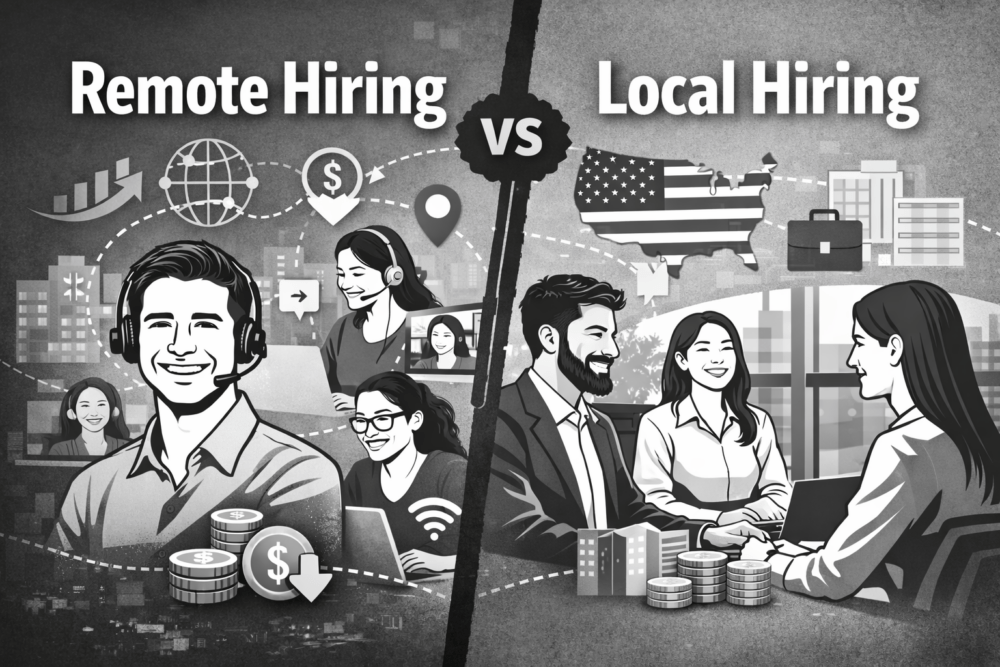
For startups and growing companies in the United States, hiring decisions directly impact speed, burn rate, and scalability. Founders and HR leaders today face a critical choice: Remote Hiring vs Local Hiring.
With talent shortages, rising salaries, and increased competition for skilled professionals, many companies are rethinking traditional hiring. Remote hiring is no longer just a cost-saving tactic — it’s a strategic growth lever.
This guide breaks down the real differences between remote and local hiring so decision-makers can evaluate cost, productivity, and ROI with clarity.
Hiring Challenges in the US
Key challenges include:
- High salary expectations in major tech hubs
- Talent shortages in engineering, product, and marketing
- Lengthy recruitment cycles
- High employee turnover rates
- Rising overhead costs (office, insurance, compliance)
Startups often compete with established companies that offer higher salaries, better benefits, and greater brand recognition. This creates friction for founders trying to build lean teams while maintaining speed.
As a result, leaders are exploring alternatives to hire local talent, including distributed teams and global workforce models.
Cost Breakdown: Local Hiring in the US
Local hiring comes with visible and hidden expenses. The actual hiring cost goes far beyond base salary.
1) Salary
- Software engineer: $110,000–$160,000/year
- SDR: $60,000–$85,000/year
- Marketing manager: $80,000–$120,000/year
2) Benefits & Insurance
- Health insurance
- Retirement contributions
- Paid leave
- Bonuses
Estimated: 20–30% of base salary
3) Overhead Costs
- Office space
- Equipment & infrastructure
- Payroll management
- Compliance and HR tools
Estimated: $10,000–$15,000 per employee annually
4) Recruitment Costs
- Agency fees
- Job platforms
- Interview hours
- Onboarding investment
Estimated: 15–25% of annual salary
Total impact: Local hiring can cost 1.5× to 2× the employee’s base salary in the first year.
Remote Hiring Cost Model
When companies hire remote employees, cost structures change significantly.
What you pay for:
- Salary aligned with global market rates
- Recruitment and vetting support
- Tools and collaboration infrastructure
- Optional compliance/payroll services
What you reduce:
- Office overhead
- Local benefits costs
- Recruitment expenses
- Relocation costs
Typical savings:
- 40–60% lower total hiring cost
- Faster hiring cycles
- Flexible scaling
Remote hiring allows startups to allocate budgets to growth initiatives rather than fixed operational costs.
Productivity Comparison: Remote vs Local Teams
One of the biggest myths around remote hiring is reduced productivity. In reality, productivity often improves when teams are structured correctly.
| Remote Team | Local Teams |
|---|---|
| >> Outcome-driven work culture >> Fewer office distractions >> Time-zone leverage for continuous work cycles >> Access to specialized talent | >> In-person collaboration >> Faster decision-making in some cases >> Stronger cultural bonding |
However, for IT startups and digital-first businesses, productivity depends more on processes and communication than geography.
High-performing remote teams typically use:
- Clear KPIs and deliverables
- Async communication
- Structured onboarding
- Performance dashboards
The result: remote teams frequently match or exceed output from traditional office setups.
Time-to-Hire Differences
Speed is a major factor in startup success.
Local hiring timeline:
- Role definition: 1–2 weeks
- Candidate sourcing: 3–6 weeks
- Interview process: 2–4 weeks
- Offer & onboarding: 2–3 weeks
Total: 8–14 weeks
Remote hiring timeline:
- Role alignment: 3–5 days
- Candidate shortlist: 5–10 days
- Interviews: 1–2 weeks
- Onboarding: 1 week
Total: 2–4 weeks
Remote hiring dramatically reduces time-to-hire, allowing startups to scale faster and capture market opportunities.
Talent Access: Global vs Local
When you hire local, your talent pool is limited to geography. When you hire remote employees, you unlock global expertise.
Remote hiring advantages:
- Specialized technical talent
- Multilingual support teams
- Round-the-clock operations
- Scalable hiring pipeline
This is especially valuable for:
- SaaS startups
- Tech product companies
- Customer support-driven businesses
- Marketing and growth teams
Case Example: Startup Scaling with Remote Hiring
A US-based SaaS startup needed to scale quickly but faced hiring constraints:
Challenge:
- Limited budget
- Need for SDRs, support, and marketing roles
- Local hiring costs were unsustainable
Solution:
- Built a remote team across operations, sales, and marketing
- Used a structured hiring and onboarding framework
Results within 6 months:
- 50% reduction in total hiring cost
- Hiring timeline reduced from 10 weeks to 3 weeks
- Increased lead generation output
- 24/7 customer support coverage
The company redirected savings into product development and customer acquisition.
ROI Comparison: Remote Hiring vs Local Hiring
| Factor | Local Hiring | Remote Hiring |
|---|---|---|
| Hiring cost | High | 40–60% lower |
| Time-to-hire | Slow | Faster |
| Talent pool | Limited | Global |
| Productivity | Office-dependent | Outcome-driven |
| Scalability | Fixed | Flexible |
| Overhead | High | Minimal |
When to Hire Local vs Remote
Hire local when:
- Roles require physical presence
- Strong in-person collaboration is essential
- Regulatory requirements demand local staff
Hire remote when:
- Roles are digital-first
- Speed and cost matter
- You need specialized talent
- You want scalable teams
Most successful startups adopt a hybrid hiring model — local leadership with remote execution teams.
Strategic Takeaway for Founders and HR Leaders
The question is no longer whether remote hiring works — it’s how to implement it effectively.
Smart companies now:
- Combine local leadership with remote execution
- Build structured onboarding processes
- Focus on outcomes instead of hours
- Use remote hiring to scale sustainably
Choosing between Remote Hiring vs Local Hiring should be driven by:
- Growth stage
- Budget realities
- Hiring urgency
- Role requirements
If you’re planning to hire in the next 30–90 days, comparing costs before making a decision is critical.
Calculate your savings and hiring timeline by evaluating:
- Salary benchmarks
- Role type
- Team structure
- Growth goals
Understanding the real cost of hiring can help you build a faster, leaner, and more scalable team.
This Post Has One Comment
A really good blog and me back again.