
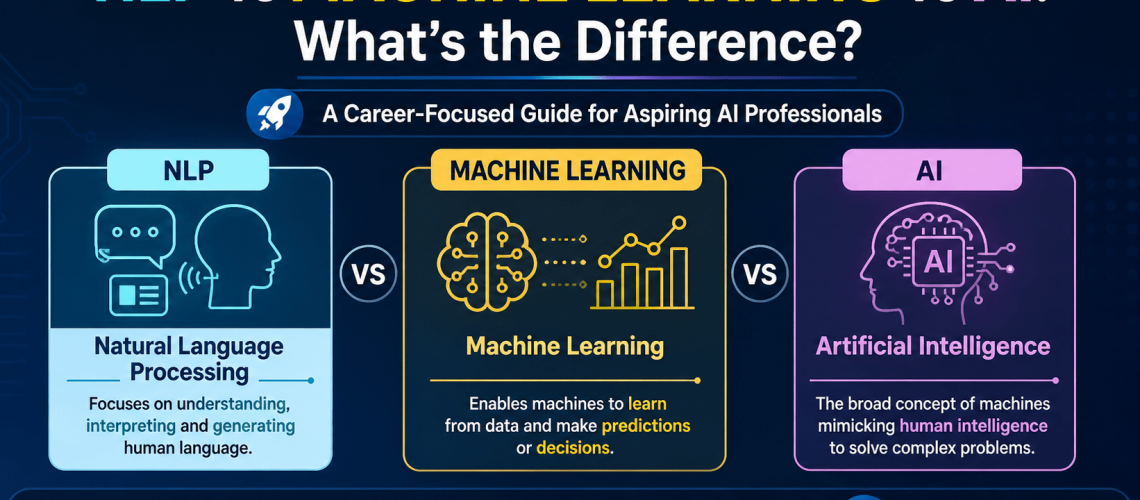
In 2026, the tech landscape isn’t just evolving; it’s being entirely rewritten by autonomous systems. For professionals eyeing career growth, the terms Artificial Intelligence (AI), Machine Learning (ML), and Natural Language Processing (NLP) are no longer just buzzwords they have become the pillars of the modern economy.
However, there is a lot of confusion regarding where one ends and the other begins. Are you an “AI Engineer” or an “ML Specialist”? Should you master Large Language Models (LLMs) or focus on predictive analytics?
This guide clears the confusion, breaking down the technical differences and, more importantly, the specific career paths and skills you need to dominate the market in 2026.
1. Hierarchy of AI
The easiest way to understand the relationship between these three is as a nested hierarchy.
- Artificial Intelligence (AI): The broadest category. It refers to any technique that enables computers to mimic human intelligence, including logic, if-then rules, and decision-making.
- Machine Learning (ML): A subset of AI. It focuses on the use of data and algorithms to imitate the way that humans learn, gradually improving its accuracy without being explicitly programmed for every task.
- Natural Language Processing (NLP): A specialized branch that often sits at the intersection of AI and Linguistics. While it uses ML techniques, its primary goal is to help machines understand, interpret, and generate human language (text and speech).
2. Artificial Intelligence (AI): The Umbrella of Self-rule
In 2026, AI is defined by Agentic Workflows. We have leaved past simple chatbots; we are now in the era of “AI Agents” that can plan, reason, and execute multi-step tasks.
Core Concept
AI is the science of making machines “smart.” This includes everything from the simple autopilot in a drone to the complex reasoning of a digital twin in a manufacturing plant.
Career Angle: The AI Generalist & Architect
If you are looking at AI career paths, you are likely looking at high-level strategy, product management, or systems architecture.
- Top Role: AI Product Manager, AI Ethics Consultant, AI Solutions Architect.
- Key Skill: Understanding how to integrate various technologies (Vision, Speech, Logic) into a cohesive business product.
3. Machine Learning (ML): The Engine Room
If AI is the car, Machine Learning is the engine. ML is the practical application of AI that allows systems to learn from experience.
Core Concept
Instead of writing a million lines of code to identify a “fraudulent transaction,” you feed an ML algorithm millions of examples of transactions. The algorithm identifies the patterns itself.
In 2026, ML has shifted toward MLOps—the practice of deploying, monitoring, and maintaining these models in real-time.
Career Angle: The ML Engineer
This is one of the highest-paying roles in tech. You aren’t just “coding”; you are building mathematical models that predict the future.
- Top Role: Machine Learning Engineer, MLOps Specialist, Data Scientist.
- Primary Keywords to Master: Supervised Learning, Neural Networks, Reinforcement Learning, Feature Engineering.
- Tools: Python, PyTorch, TensorFlow, Scikit-Learn.
4. Natural Language Processing (NLP): The Voice of the Future
NLP is the reason you can talk to your house, and it’s the technology behind the Generative AI explosion (ChatGPT, Gemini, Claude).
Core Concept
Human language is messy, sarcastic, and full of context. NLP uses ML to break down language into “tokens” and “vectors” so a computer can understand the intent behind the words.
Career Angle: The Language Specialist
With the rise of Retrieval-Augmented Generation (RAG) and Prompt Engineering, NLP experts are in massive demand to help companies talk to their own data.
- Top Role: NLP Engineer, LLM Developer, Conversational AI Designer.
- Secondary Keywords: Transformers, Tokenization, Sentiment Analysis, Named Entity Recognition (NER).
- Must-Have Skill: Fine-tuning Large Language Models and building RAG pipelines.
5. Comparison Table: AI vs. ML vs. NLP
| Feature | Artificial Intelligence (AI) | Machine Learning (ML) | Natural Language Processing (NLP) |
| Goal | Mimic human intelligence. | Learn from data to improve accuracy. | Understand and generate human language. |
| Scope | Extremely broad (Robotics, Vision, Logic). | Subset of AI focused on algorithms. | Subset of AI/ML focused on linguistics. |
| Real-world Example | A self-driving car navigating a city. | A Netflix recommendation “Because you watched…” | A real-time translation app or a chatbot. |
| Career Entry | AI Product Management, Strategy. | Mathematical modeling, Data Engineering. | Computational Linguistics, LLM Tuning. |
6. How to Choose Your Career Path in 2026
The “best” path depends on your personality and technical appetite.
Path A: The Math-Heavy Architect (ML)
If you love statistics, calculus, and optimizing code for efficiency, Machine Learning is your home. You will spend your days looking at data distributions and loss functions.
- Focus: Accuracy, Precision, and Scalability.
Path B: The Linguistic Creator (NLP)
If you are fascinated by how language works and want to build the next generation of digital assistants, NLP is where the excitement is. You’ll work with “Attention” mechanisms and semantic embeddings.
- Focus: Context, Intent, and Human Interaction.
Path C: The Strategic Visionary (AI)
If you enjoy “the big picture”—how tech solves business problems—focus on AI Systems. You’ll manage how the ML models and NLP interfaces come together to create a product.
- Focus: Implementation, Ethics, and User Experience.
7. The 2026 Skill Stack for Career Growth
To stay relevant, you need a T-shaped skill set: broad knowledge across AI, but deep expertise in one area.
- Programming: Python is the undisputed king. Master libraries like Pandas for data and FastAPI for deployment.
- Generative AI & LLMs: Understand how to build with LangChain or LlamaIndex.
- Cloud Platforms: You cannot do modern AI on a laptop. Learn AWS SageMaker, Google Vertex AI, or Azure AI.
- AI Ethics & Governance: As regulations like the EU AI Act become standard, knowing how to build responsible AI is a massive career advantage.
Conclusion: The Convergence
While we distinguish between NLP, Machine Learning, and AI, the reality of 2026 is that they are converging. A modern “AI Engineer” must understand the ML models that power the system and the NLP interfaces that allow humans to use it.
If you are looking for career growth, don’t just learn a tool—learn the architecture. Start by mastering Machine Learning fundamentals, then pivot into a specialization like NLP or Computer Vision. The demand for these skills is projected to outpace supply for the next decade.
Are you ready to build the future, or just live in it? The choice starts with your next learning path.
What specific area of AI development are you most interested in—building the underlying models, or designing the interfaces that people interact with?