
We’ve all been there. You have a job opening, and you’ve spent weeks crafting the “perfect” description. You’re looking for a “rockstar” or a “unicorn”—someone who hits every single bullet point, possesses fifteen years of experience in a five-year-old technology, and fits the company culture like a bespoke suit.
But here’s the cold, hard truth: If you actually find that 100% match, they will probably quit within six months.
Why? Because if a candidate can already do 100% of the job on day one, they have nowhere to go but sideways. They are already overqualified, and the “new job smell” will wear off the moment they realize there is nothing left for them to learn.
This is where the 70% Rule of Hiring comes in. It’s a shift in perspective that moves away from hiring for past completion and starts hiring for future potential. Whether you are an HR professional, a startup founder, or a department lead, understanding this rule is the key to solving the retention crisis and building a team that actually grows with your company.
The Anatomy of the 70% Rule: The “Goldilocks” Zone
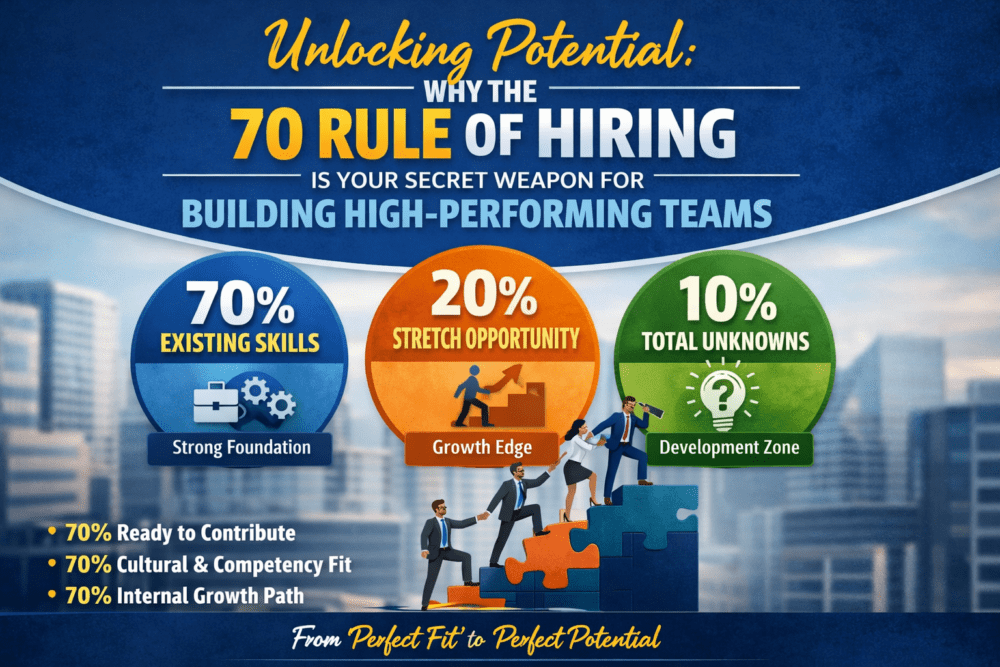
At its core, the 70% Rule (often derived from the 70-20-10 Learning Model) suggests that the ideal candidate should meet roughly 70% of your requirements. The remaining 30% is where the magic happens.
1. The 70%: The Foundation
These are the non-negotiables. This person has the core technical skills, the necessary industry context, and the foundational experience to be functional within their first few weeks. They aren’t starting from scratch; they speak the language of the role. If you’re hiring a Senior Graphic Designer, they should already know the Adobe Suite inside and out. That’s the 70%.
2. The 20%: The Stretch
This is the “growth gap.” This 20% represents tasks or responsibilities the candidate hasn’t quite mastered yet but can tackle. Perhaps that designer has never managed a junior or hasn’t worked on motion graphics before. By including this gap, you give the hire a reason to stay late, ask questions, and stay engaged. You are giving them a promotion in responsibility, even if the job title is a lateral move.
3. The 10%: The Unknown
This is the “deep end” of the pool. These are the elements of the job that are completely new to the candidate—perhaps specific proprietary software or a unique company methodology. This 10% requires formal mentorship and patience. It humbles the high-performer and reminds them that they are part of a system larger than their own ego.
Hire for Attitude, Train for Skill: The Competency Shift
Another way to look at the 70% Rule is through the lens of Competency vs. Capability. Research consistently shows that 70% of a new hire’s long-term success is determined by “soft skills”—emotional intelligence, adaptability, and grit—while only 30% is tied to technical proficiency. We often make the mistake of reversing these priorities during the interview process. We spend 50 minutes grilling someone on their Excel formulas and 10 minutes asking how they handle conflict.
When you adopt the 70% Rule, you stop looking for the person who has done the work and start looking for the person who can do the work.
Pro-Tip: It is significantly easier to teach a curious, motivated person how to use a CRM than it is to teach a technical expert how to stop being toxic in Slack channels.
The 70/30 Sourcing Strategy: Internal vs. External
The 70% Rule also applies to how you structure your entire organization’s growth. A healthy company follows a 70/30 Sourcing Split:
- 70% Internal Moves: You should aim to fill the majority of your senior roles by promoting from within. This preserves “tribal knowledge” and proves to your entry-level staff that there is a ladder worth climbing.
- 30% External Hires: You must bring in 30% of your talent from the outside to prevent “groupthink.” New blood brings new perspectives, different ways of solving problems, and keeps the internal culture from becoming stagnant or “incestuous.”
Why “Perfect Matches” Are Actually High-Risk Hires
It sounds counterintuitive, doesn’t it? Why wouldn’t you want the person who has done this exact job for ten years?
- The Flight Risk: A 100% match is looking for a paycheck, not a career move. The moment a competitor offers 10% more, they’re gone because they have no emotional or intellectual investment in “learning” your business.
- The “We Did It This Way At My Old Job” Syndrome: Someone who is a 100% match often arrives with rigid habits. They aren’t looking to adapt; they’re looking to replicate.
- The Lack of Hunger: High performers are driven by the “Aha!” moment. If there are no “Aha!” moments left in the job description, the fire goes out.
How to Implement the 70% Rule Tomorrow
How to Implement the 70% Rule Tomorrow
If you’re ready to stop chasing unicorns and start building a stable, hungry team, here is how you adjust your process:
- Rewrite Your Job Ads: Distinguish between “Must-Haves” (the 70%) and “Growth Opportunities” (the 30%). Use language like: “You will bring [Skill A] to the table, and we will help you develop [Skill B].”
- Interview for Learning Agility: Ask questions like, “Tell me about a time you were way out of your depth. How did you get up to speed?” If they can’t answer that, they won’t survive the 30% gap.
- Build a “Learning Budget”: If you are intentionally hiring people who are a 70% match, you must be prepared to support the remaining 30%. This means having a solid onboarding plan and a culture of mentorship.
Conclusion
The 70% Rule isn’t about “settling” for less-than-perfect candidates. It’s about recognizing that perfection is static, while growth is dynamic. When you hire a 70% match, you aren’t just filling a seat; you’re starting a partnership. You are betting on their potential, and in return, they give you their loyalty and their best creative energy as they work to close that 30% gap.
In a world where talent is harder to find than ever, the companies that win won’t be the ones with the most impressive resumes on file—they’ll be the ones with the best learners on staff.